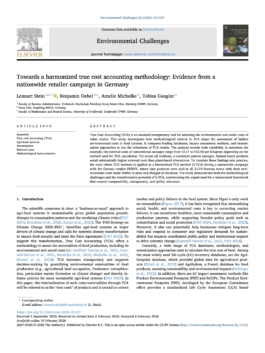
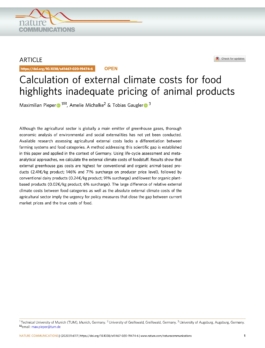
Although the agricultural sector is globally a main emitter of greenhouse gases, thorough economic analysis of environmental and social externalities has not yet been conducted. Available research assessing agricultural external costs lacks a differentiation between farming systems and food categories. A method addressing this scientific gap is established in this paper and applied in the context of Germany. Using life-cycle assessment and meta-analytical approaches, we calculate the external climate costs of foodstuff. Results show that external greenhouse gas costs are highest for conventional and organic animal-based products (2.41€/kg product; 146% and 71% surcharge on producer price level), followed by conventional dairy products (0.24€/kg product; 91% surcharge) and lowest for organic plant-based products (0.02€/kg product; 6% surcharge). The large difference of relative external climate costs between food categories as well as the absolute external climate costs of the agricultural sector imply the urgency for policy measures that close the gap between current market prices and the true costs of food.
Maximilian Pieper, Amelie Michalke, Tobias Gaugler

Although the agricultural sector is globally a main emitter of greenhouse gases, thorough economic analysis of environmental and social externalities has not yet been conducted. Available research assessing agricultural external costs lacks a differentiation between farming systems and food categories. A method addressing this scientific gap is established in this paper and applied in the context of Germany. Using life-cycle assessment and meta-analytical approaches, we calculate the external climate costs of foodstuff. Results show that external greenhouse gas costs are highest for conventional and organic animal-based products (2.41€/kg product; 146% and 71% surcharge on producer price level), followed by conventional dairy products (0.24€/kg product; 91% surcharge) and lowest for organic plant-based products (0.02€/kg product; 6% surcharge). The large difference of relative external climate costs between food categories as well as the absolute external climate costs of the agricultural sector imply the urgency for policy measures that close the gap between current market prices and the true costs of food.
Maximilian Pieper, Amelie Michalke, Tobias Gaugler
©True Cost Alliance. All rights reserved. Legal Note Privacy Policy Website by Studio Christian Vukomanovic
Stay up to date on news, projects, and research
Sign up with your email and receive our newsletter. You can find information on how your data is stored and used, as well as your unsubscribe options, in our privacy policy.
©True Cost Alliance. All rights reserved. Legal Note Privacy Policy Website by Studio Christian Vukomanovic