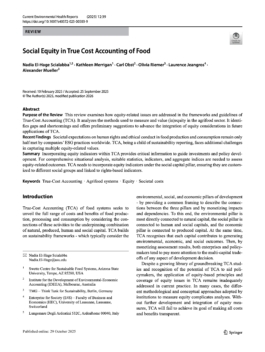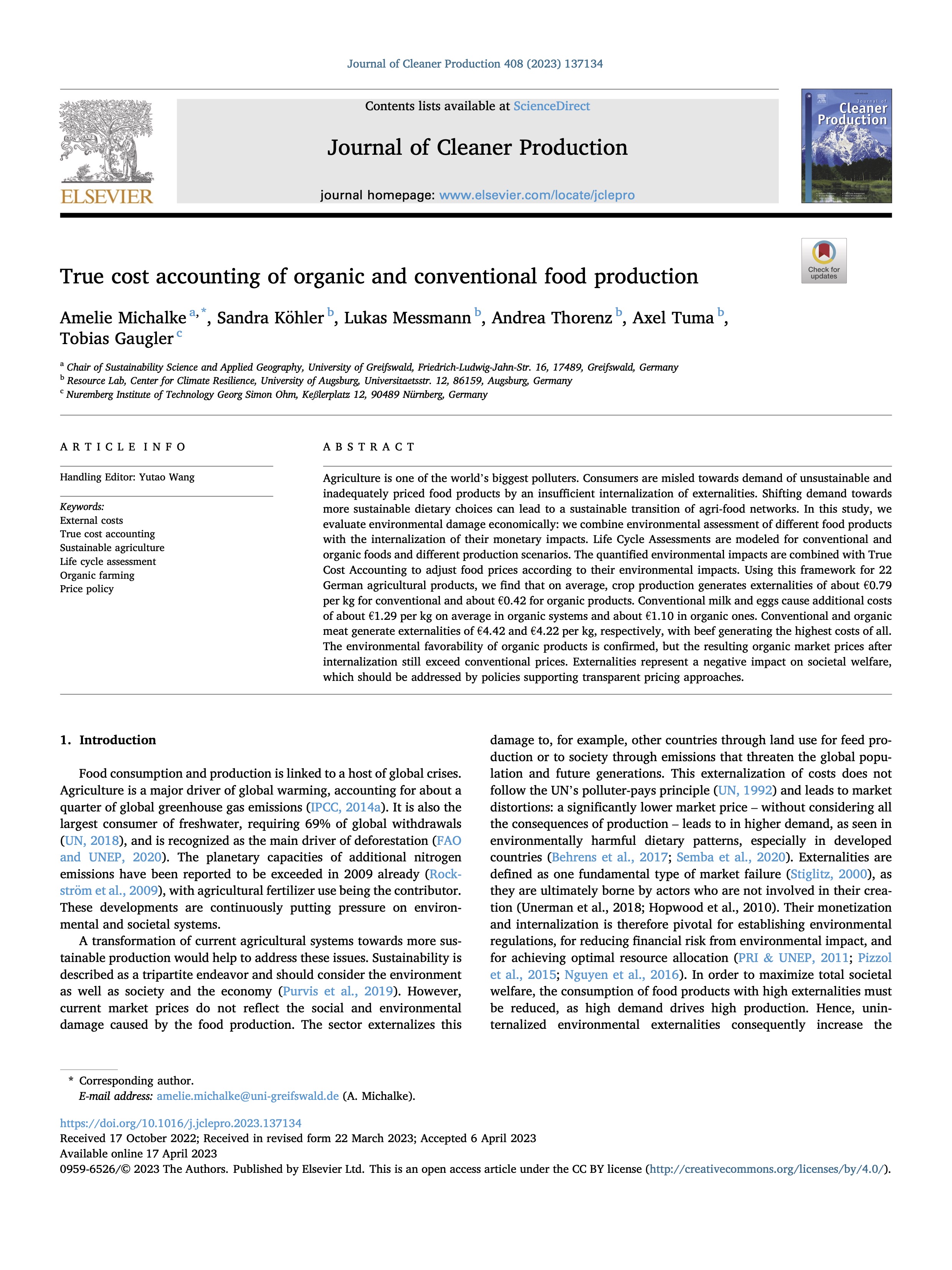
Agriculture is one of the world’s biggest polluters. Consumers are misled towards demand of unsustainable and inadequately priced food products by an insufficient internalization of externalities. Shifting demand towards more sustainable dietary choices can lead to a sustainable transition of agri-food networks. In this study, we evaluate environmental damage economically: we combine environmental assessment of different food products with the internalization of their monetary impacts. Life Cycle Assessments are modeled for conventional and organic foods and different production scenarios. The quantified environmental impacts are combined with True Cost Accounting to adjust food prices according to their environmental impacts. Using this framework for 22 German agricultural products, we find that on average, crop production generates externalities of about €0.79 per kg for conventional and about €0.42 for organic products. Conventional milk and eggs cause additional costs of about €1.29 per kg on average in organic systems and about €1.10 in organic ones. Conventional and organic meat generate externalities of €4.42 and €4.22 per kg, respectively, with beef generating the highest costs of all. The environmental favorability of organic products is confirmed, but the resulting organic market prices after
internalization still exceed conventional prices. Externalities represent a negative impact on societal welfare, which should be addressed by policies supporting transparent pricing approaches.
Amelie Michalke, Sandra Köhler, Lukas Messmann, Andrea Thorenz, Axel Tuma, Tobias Gauglerc

Agriculture is one of the world’s biggest polluters. Consumers are misled towards demand of unsustainable and inadequately priced food products by an insufficient internalization of externalities. Shifting demand towards more sustainable dietary choices can lead to a sustainable transition of agri-food networks. In this study, we evaluate environmental damage economically: we combine environmental assessment of different food products with the internalization of their monetary impacts. Life Cycle Assessments are modeled for conventional and organic foods and different production scenarios. The quantified environmental impacts are combined with True Cost Accounting to adjust food prices according to their environmental impacts. Using this framework for 22 German agricultural products, we find that on average, crop production generates externalities of about €0.79 per kg for conventional and about €0.42 for organic products. Conventional milk and eggs cause additional costs of about €1.29 per kg on average in organic systems and about €1.10 in organic ones. Conventional and organic meat generate externalities of €4.42 and €4.22 per kg, respectively, with beef generating the highest costs of all. The environmental favorability of organic products is confirmed, but the resulting organic market prices after
internalization still exceed conventional prices. Externalities represent a negative impact on societal welfare, which should be addressed by policies supporting transparent pricing approaches.
Amelie Michalke, Sandra Köhler, Lukas Messmann, Andrea Thorenz, Axel Tuma, Tobias Gauglerc
©True Cost Alliance. All rights reserved. Legal Note Privacy Policy Website by Studio Christian Vukomanovic
Stay up to date on news, projects, and research
Sign up with your email and receive our newsletter. You can find information on how your data is stored and used, as well as your unsubscribe options, in our privacy policy.
©True Cost Alliance. All rights reserved. Legal Note Privacy Policy Website by Studio Christian Vukomanovic