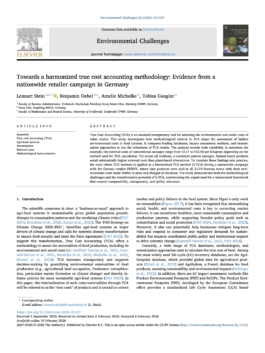
True Cost Accounting (TCA) is an essential transparency tool for assessing the environmental and social costs of value chains. This study investigates how methodological choices in TCA shape the assessment of hidden environmental costs in food systems. It compares leading databases, impact assessment methods, and monetization approaches to test the robustness of TCA results. The analysis reveals wide variability in outcomes: for example, the external costs of conventional sausages range from €2.17 to €22.50 per kilogram depending on the method used for TCA calculation. Yet across all methods, a consistent pattern emerges: Animal-based products entail substantially higher external costs than plant-based alternatives. To translate these findings into practice, the most robust TCA estimate is applied as a harmonized TCA method (h-TCA) during a nationwide campaign with the German retailer PENNY, where nine products were sold in all 2,119 German stores with their environmental costs made visible in store and charged at checkout. The study demonstrates both the methodological challenges and the transformative potential of h-TCA, underscoring the urgent need for a harmonized framework that ensures comparability, transparency, and policy relevance.
Lennart Stein, Benjamin Oebel, Amelie Michalke, Tobias Gaugler

True Cost Accounting (TCA) is an essential transparency tool for assessing the environmental and social costs of value chains. This study investigates how methodological choices in TCA shape the assessment of hidden environmental costs in food systems. It compares leading databases, impact assessment methods, and monetization approaches to test the robustness of TCA results. The analysis reveals wide variability in outcomes: for example, the external costs of conventional sausages range from €2.17 to €22.50 per kilogram depending on the method used for TCA calculation. Yet across all methods, a consistent pattern emerges: Animal-based products entail substantially higher external costs than plant-based alternatives. To translate these findings into practice, the most robust TCA estimate is applied as a harmonized TCA method (h-TCA) during a nationwide campaign with the German retailer PENNY, where nine products were sold in all 2,119 German stores with their environmental costs made visible in store and charged at checkout. The study demonstrates both the methodological challenges and the transformative potential of h-TCA, underscoring the urgent need for a harmonized framework that ensures comparability, transparency, and policy relevance.
Lennart Stein, Benjamin Oebel, Amelie Michalke, Tobias Gaugler
©True Cost Alliance. All rights reserved. Legal Note Privacy Policy Website by Studio Christian Vukomanovic
Stay up to date on news, projects, and research
Sign up with your email and receive our newsletter. You can find information on how your data is stored and used, as well as your unsubscribe options, in our privacy policy.
©True Cost Alliance. All rights reserved. Legal Note Privacy Policy Website by Studio Christian Vukomanovic