
Image: TMG
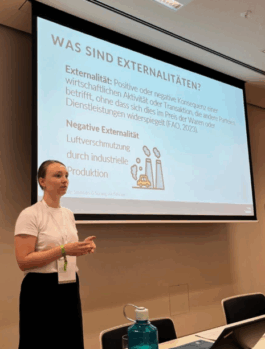
At the end of June, TMG’s Carmen Steinmetz led an interactive workshop at the 2025 Youth Policy Days (JugendPolitikTage) on the topic of "TRUE COST: What Our Food Really Costs." Around 1,000 participants aged 16 to 27 from across Germany gathered in Berlin to discuss key political issues of our time. Using the examples of chocolate and kebabs, the workshop explored the hidden costs of production and consumption. The discussion focused on who bears responsibility for the true cost of our food. Many of the 17 workshop participants primarily saw polluters, such as companies and farmers, as responsible. However, the discussion made it clear that the government and consumers also have a significant influence on production processes and consumption behavior. Participants preferred communication in the form of information about the true costs—for example, as an additional price on the label—and thought that this information should also be provided in schools and universities. An open discussion focused on which external costs are easiest to reduce and how this can be achieved, as well as ideas such as taxes on sugary products, a ban on advertising for unhealthy foods (including on social media), and accounting for the high costs of alcohol consumption. The workshop was conducted in cooperation with the German Federal Ministry of Agriculture, Food and Regional Identity (BMLEH) as part of TMG’s TCA Roadmap project, which is funded by the EU NextGenerationEU program.
June 2025
Berlin
Image: TMG
At the end of June, TMG’s Carmen Steinmetz led an interactive workshop at the 2025 Youth Policy Days (JugendPolitikTage) on the topic of "TRUE COST: What Our Food Really Costs." Around 1,000 participants aged 16 to 27 from across Germany gathered in Berlin to discuss key political issues of our time. Using the examples of chocolate and kebabs, the workshop explored the hidden costs of production and consumption. The discussion focused on who bears responsibility for the true cost of our food. Many of the 17 workshop participants primarily saw polluters, such as companies and farmers, as responsible. However, the discussion made it clear that the government and consumers also have a significant influence on production processes and consumption behavior. Participants preferred communication in the form of information about the true costs—for example, as an additional price on the label—and thought that this information should also be provided in schools and universities. An open discussion focused on which external costs are easiest to reduce and how this can be achieved, as well as ideas such as taxes on sugary products, a ban on advertising for unhealthy foods (including on social media), and accounting for the high costs of alcohol consumption. The workshop was conducted in cooperation with the German Federal Ministry of Agriculture, Food and Regional Identity (BMLEH) as part of TMG’s TCA Roadmap project, which is funded by the EU NextGenerationEU program.
June 2025
Berlin